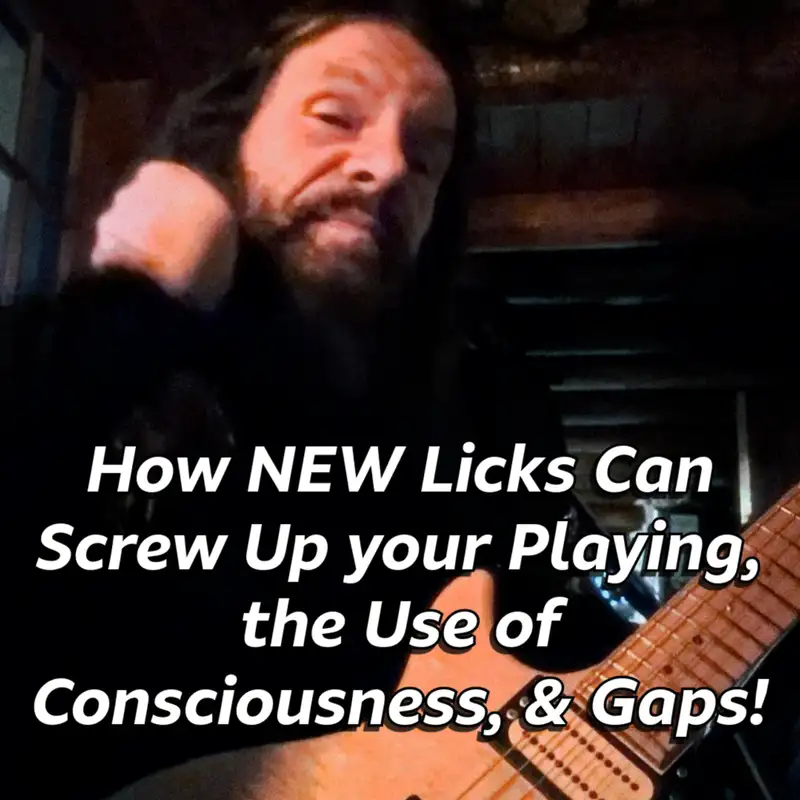
Ep. 29: How NEW Licks Can Screw Up your Playing, the Use of Consciousness, & Gaps!
It is early, early, early morning on this Sunday. Sunday, a divine day. As are weekends in general. In the oscillation of life, the up and down, obviously, gaps are needed and breaks. And music, of course, is full of gaps and breaks of whole notes and quarter notes and half notes.
Speaker 1:But that's, you know, life. And just a couple points related to guitar and life. Perhaps they're inseparable in my humble opinion, and I have been humbled in my life, you know, so many times. We're learning things all the time. We're evolving as a species, as an individual organism.
Speaker 1:Our guitar playing evolves. And, you know, we... We're incorporating new things all the time. I mean, I certainly don't play guitar like I did when I was 17. Now, you know, and these phases or gaps, you know, of a gap is is kind of a phase and everything too.
Speaker 1:Like, sometimes, you know, you'll get the idea or you'll be influenced by a guitar player with a certain run or whatever. And you introduce this new element to your playing, and suddenly you're like all screwed up. It's like you're you're trying to work the new lick into your your muscle memory, your mechanics. Mhmm. And and suddenly, it's like, well, that's not, you know, working for me, or that's really screwed up.
Speaker 1:And, you know, you kinda, you know, sometimes lose a little confidence even because you get what you perceive as bad notes as you're learning until... I'll say this. Normally, it's it's until in the mind that lick, you know what it's gonna sound like when you make that run, like, you know, a turnaround kind of thing, like, you know, like like like that, you know, or more extensive version of it, you know, where you start with the note and you end up with the note and you and you and you turn it around. Well... Okay.
Speaker 1:Let's just say that's that's our example. You introduce it, and suddenly, you're you're trying to you intellectually go, man, I'd like to do that here, but you don't quite hear it in your head, so it's weird. And I think the crazy thing is that you can practice this and, you know, and, hey. I got that. But I find that often you don't really get it until you sleep on it.
Speaker 1:Like, you know, you you know, you work at it a thousand times, whatever the... And then you wake up. And there's something that happens, I think, in in the sleep process that integrates that lick or that new knowledge with you. And and, again, that's one of the... My fascinations of why I I did all the joint ventures and contracts and deals with all these science companies.
Speaker 1:Everyone always thinks, well, Andrew's, you know, put out all this music and stuff, but yet we did all this work with consciousness and, you know, with sound waves and all that. At the Monroe Institute, we've had contracts with them and different entities, you know, through the years and have put out these mind products to help people get into more fluid states of consciousness. So we've done that in our hospice businesses as well, and just helping caregivers relax, but in patients, if they're agitated, we can put sound waves on. And we know that certain modulations of those frequencies, whether it's hemisync, whether it's SAM that is spatial angular modulation techniques, You know, they they change the brain. But what I'm getting at here is the sleep state is involved, and there's something that happens in the sleep state.
Speaker 1:And then the state after the sleep state, which is the lucid state between the waking state and the sleeping state, you know, there's miraculous things that happen there. Like, a lot of times, I think people, you know, they want to spring out of bed to be very, very productive in their lives. And I'm certainly one that does that, Mr. Overproductivity sometimes. Whereas if we just lay back and say, Man, this bed feels very good today, and you think about, you know, your day or whatever's troubling you or the problem that you're trying to solve, and you'll find so often the solutions, you know, to those things, in that in between state, especially.
Speaker 1:If... And the trick is when you're in the in between, it's... You know, you get the great idea, and how do you record it? Because you almost have to come out of that state in order to capture it in, you know, material world, you know, through your... Like, my guitar journal here.
Speaker 1:You know, I have to write it down. And, of course, you always have to write write, in my opinion, either recording devices or notepads. And, obviously, writing utensils near your bed so that, you know, you can capture these things. Okay. Back to the topic.
Speaker 1:We introduce something new. We sleep on it. It... Then it becomes, you know, part of us. But the crazy thing is that there's some guitar players.
Speaker 1:I prefer them before they learned different techniques because I have just noticed that watching, you know, say over decades or or half a decade or or what have you, Different artists, whatever their span of time is. I don't mean to define it like that. Where you enjoy their playing earlier in their career when they're perhaps a little more fluid about, you know, everything or there's just certain knack or twitch about the way they go about things. And then later on, you know, they've quote advanced. They've incorporated more licks into their overall style.
Speaker 1:And they're... It's not as enjoyable, at least to me. Or I'm expecting the old and I get the new version of the guitar player. Now with that said, you know, both states are great. You know, the previous state, you know, epic because that's where you are at that time, and you can't be expected to do anything other than that.
Speaker 1:But the new is great and necessary. And then sometimes you can revert back to the old and go, I kind of like the way I used to play before I threw in the extra notes. The more minimalistic thing. The point is it's it's all technically okay in the end. Nice carbon here.
Speaker 1:I love the seventies carbons. You know, stereo outputs, which is really odd. In this... If you're a studio rat, like, you know, like myself, Yeah. That's a weird feature that, you know, you can have two outputs, you know, from your guitar, and it gives you more options.
Speaker 1:But, you know, I was just thinking about this this morning. I had a song just pop up, and I'm doing that. I mean, that's the way it happens for me. But there's some impulse in me to, you know, go for an idea or whatever or expression, you know. It's on a Sunday like this, you know, I tend to be thankful, a bit reflective and contemplative.
Speaker 1:I'm gonna go down to the church in a little bit and play down there. Take in nature, my teacher, of how life actually works. You can learn a lot from watching all the birds and the hawk, all the creatures, and the way that they operate in life, you know, as a bird of the air. How they can be startled, they can fly off, they can... And...
Speaker 1:But, you know, back to, you know, like songs and idea. Okay. So today, you know, I just had this impulse of gratefulness, so, you know, that's the kind of song that came out. And and songs are a strange thing. Like, when the first...
Speaker 1:My first radio song... You know, first time I ever had anything on the radio, and this was mainly in the Midwest. It was Camel Records. It's called In the Back of My Mind, and it was released a few years ago. Pulled back, and then hopefully Virgin and the whole Universal folks.
Speaker 1:I'd like to get, you know, some of those recordings re released and everything, but it's called in the back of my mind, and that was where it was at that time. You know, that was my songwriting. Whereas today, you know, my writing's different, And that's the whole thing. I look back at even my old songs, and I go, where in the hell did that come from? Like, you know, who wrote that?
Speaker 1:What kind of consciousness? What was I going through or thinking about at the time? And sometimes you can remember it, and sometimes you can't. But, you know, we just evolve, you know, and being okay with that. And yeah, oh, God.
Speaker 1:God, that's, you know, that's a great song. How did I come up with that? And, you know, the mystery of life. I think we're all mysteries to ourselves. Sometimes people say, Oh, know thyself, as the great sage's words, well, the truth is we can't, at least really.
Speaker 1:And by not understanding ourselves completely, it was a great thrill in that. Because if you had it all worked out, it's like, oh, this is boring, you know, and monotonous, and eating meatloaf every day. Whereas, like I say, spaghetti is pretty good too, and something different, but we all want new. I think this is where we want new. We want more, if possible.
Speaker 1:And there's nothing wrong with that. I mean, that's what drives our species forward, and all things to evolve, to be reaching for that next thing, for the oak tree to want to extend that branch. But we don't know ourselves. Not really. I think that mystery of life is an incredible thing and gives us constant thrills if we can get us that bird of the air and have a relatively calm disposition towards it that saying, Oh, that thing about ate me.
Speaker 1:That snake about got me. By the way, I'm surrounded by snakes. I've not had that many encounters. People always just freak out. They're all over Spiders, all bees, you know, people.
Speaker 1:Yeah. Once in a while, you may have some encounter if you... Whatever, but you can't live in fear. I mean, risk is every place. Always do that last note.
Speaker 1:So we don't know ourselves. I'm talking. You always think that, and he's kinda going in a circle, but then I I come back. At some point, this is gonna make sense. Although it is a bit of a stream of consciousness.
Speaker 1:But yeah, just the acceptance of change, of movement that's in the DNA of the world, that things are changing all the time despite our best efforts to try to preserve the current moment or condition, which some people try to do, and they're obviously frustrated by this. Right? So, our guitar playing the songs we produce, and they're periods of time. Just think about myself. You know, here, I make this philosophical observation about life and change and all attempts to preserve the past, you know, folly, vain, or whatever.
Speaker 1:Yet, the very process of recording a song is the attempt to capture this, and why I prefer recording to live performance. Because, you know, to me, the thrill of... I mean, I... Maybe live performance is much more zen. Like, you're experiencing the audience, the interaction, and there's a certain thrill of that.
Speaker 1:But... And and it's great. But to me, again, and capturing and playing with sounds, sonic sensations, is just thrilling to me. So there's nothing wrong as far as one person gravitating to one thing and not another, or, you know, having some preferences. That's part of individuality.
Speaker 1:Individualization, as some people might say, in a more intellectual context. Okay. Some people are afraid of those kind of breaks there, those uncomfortable... What they perceive as uncomfortable gaps where they feel like they they always have to be filling it in with some talk or whatever. There's no nest, or it's not needed.
Speaker 1:Is it? Anyway, those are just a few points, you know, sharing about introduction of new materials, how it changes your playing, how sometimes the old sometimes might be better, and that we don't understand ourselves. Not really. Not if we're in our honest moments. We have to acknowledge that the world's beyond us.
Speaker 1:Even though we want to understand the world, our brains are problem solving machines. We want to work out how this world works, and there's certainly, you know, survival and profit value and entertainment value, you know, from that. But again, we're a species with five senses to interpret the world. Six if we stretch it, maybe. We're not like Voltaire's, you know, beings with 72 senses to interpret the world who lived 15,000.
Speaker 1:No. And there's, you know, infinite things happening all the time. I mean, the world is infinite. Every direction, whether we go to, you know, the Titanic, you know, all the billions of galaxies, You know, it's huge down to the microscopic and below, there's just things we just are unaware of because it is so infinite in every direction. So how could we be expected to understand and work out the world with five senses?
Speaker 1:But with those five senses, perhaps six, we do our best with it without any judgment or condemnation. Of how it is. Anyway, enough of my nonsense for this Sunday. It's time to get up, enjoy it. It may look like it's a great day out there, but in my mind, it's sunny.
Speaker 1:And I'm going to play my... Andrew's version of James Taylor's Secret of Life again, and just because there's really something to it, and and it's a great practice song. So my picking technique.
Speaker 2:The secret of life is enjoying the passage of time. Anyone can do it. They nothing do it. Nobody knows how we got to the top of the hill. And since we're only here for a while, we might as well do it with style.
Speaker 2:And I'm gonna add in a smile and see a sunny day,
Speaker 1:even though it's great today.
Speaker 2:The secret of life is enjoying everyday things. When you wash the dishes, don your socks with stitches, nobody knows how we got to the top of the hill. And since we're only here for a while, we might as well do it with style. And I'm gonna throw in a smile and see a sunny day. Sunny day.
Speaker 1:Sunny day.
Speaker 2:Sunny day.
Speaker 1:Sunny day. Have a great day.